Mini Baking Embroidery Bundle Review
As an embroidery designer who has spent years digitizing and testing files for commercial use, I approach every new machine embroidery design with a critical eye. It is not just about whether a motif looks cute on a screen; it is about how that design performs under the needle, how it translates to fabric, and ultimately, how it serves the business goals of my clients. Recently, I had the opportunity to evaluate the Mini Baking Embroidery Bundle, a collection that promises to bring charm to baked goods-themed merchandise. For small business owners, boutique operators, and apparel decorators, understanding the practical application of such assets is crucial before investing time and materials.
First Impressions and Visual Personality
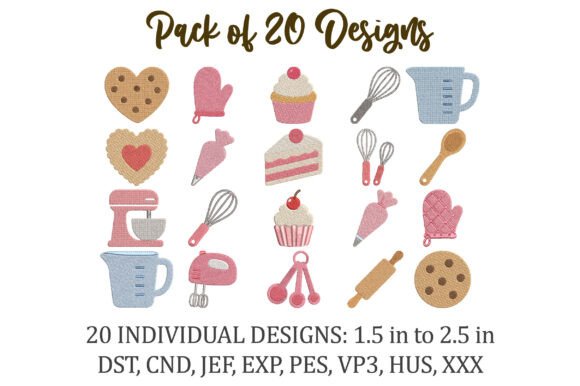
The initial impression of the Mini Baking Embroidery Bundle is one of approachable warmth. The description highlights adorable elements like cupcakes, cookies, whisks, rolling pins, measuring cups, oven mitts, and cake slices. Visually, this suggests a style that is playful, handmade, and friendly rather than starkly modern or ultra-minimalist. For brands in the Food category, particularly bakeries, cafes, and home-based confectioners, this aesthetic aligns perfectly with a brand identity that values comfort and artisanal quality.
However, "adorable" can sometimes translate to "cluttered" if not managed correctly in digitization. My primary concern with any bundle featuring multiple small objects is the balance between detail and stitch efficiency. A design that is too dense may pucker lightweight fabrics, while one that is too sparse might lack the visual impact needed for branded merchandise. The key here is versatility. Does this digital embroidery file set offer enough variation to be used across different product types without losing its core appeal?
Real-World Business Applications
When considering small business merch, the utility of a design bundle is measured by its adaptability. The Mini Baking Embroidery Bundle shines in several specific commercial applications. For a local bakery, these motifs are ideal for staff uniforms. Imagine a simple whisk or cupcake icon embroidered on the chest pocket of an apron. This subtle branding reinforces professionalism without overwhelming the garment. It creates a cohesive look that customers associate with quality and care.
Beyond uniforms, these designs are excellent for custom apparel sold as retail items. Tote bags are a staple for grocery runs and farmers' market visits. A well-placed cookie or rolling pin design on a canvas tote transforms a utilitarian item into a walking advertisement for your brand. Similarly, cap embroidery benefits from smaller, self-contained motifs. A single cupcake or slice of cake on the front panel of a baseball cap can serve as a recognizable logo mark, provided the scale is adjusted correctly.
For Etsy sellers and crafters, this bundle offers immediate value for creating handmade product labels or tags. Small embroidered patches featuring oven mitts or measuring cups can be sewn onto packaging, adding a tactile, premium feel to the unboxing experience. This attention to detail builds customer trust and encourages social media sharing, which is vital for organic growth.
Navigating Technical Challenges
While the charm of the Mini Baking Embroidery Bundle is evident, technical execution requires caution. One of the most common pitfalls in commercial Embroidery is ignoring stitch density and fabric compatibility. Small details, such as the sprinkles on a cupcake or the markings on a measuring cup, can become lost if the thread tension is not calibrated or if the fabric texture is too rough.
I recommend testing these designs on the actual materials you intend to use. For dark uniforms, ensure that the thread colors provide sufficient contrast. Pastel threads on navy blue aprons may look elegant in a mockup but can appear washed out in person. Additionally, curved surfaces like cap fronts require careful hooping and stabilizer selection to prevent distortion. If the design includes fine lines, such as the handle of a whisk, verify that the digitizing uses appropriate underlay stitches to anchor the top stitching securely.
Another consideration is washability. Merchandise like aprons and tote bags undergo frequent laundering. Designs with high stitch counts or loose connections between elements may fray over time. Before committing to a large production run, wash-test a sample piece to ensure the integrity of the embroidered patch or direct embroidery holds up to industrial or home washing cycles.
Enhancing Brand Identity and Value
Incorporating the Mini Baking Embroidery Bundle into your product line does more than add decoration; it strengthens your brand identity. Consistent visual elements across various touchpoints—from staff uniforms to packaging accents—create a sense of reliability and professionalism. When customers see the same high-quality cupcake or cookie motif on your website, your physical store, and the product they take home, it reinforces brand recognition.
Furthermore, embroidered items perceive higher value than printed ones. The texture and dimensionality of Embroidery signal craftsmanship. For a boutique or creative studio, offering merchandise featuring these designs can increase average order value. Customers are often willing to pay a premium for items that feel bespoke and durable. This bundle allows businesses to create a cohesive suite of design assets that elevate the perceived quality of their offerings.
Practical Designer Notes for Implementation
To maximize the potential of the Mini Baking Embroidery Bundle, follow these practical steps before full-scale production:
- Test in Monochrome: Stitch out the designs in black thread on white fabric first. This reveals the structural integrity of the digitizing without the distraction of color. If it looks good in black and white, it will look great in color.
- Check Scale and Hoop Size: Verify the recommended hoop size for each motif. Ensure that the design fits comfortably within your machine’s capabilities and the intended garment area. Do not force a large design into a small hoop, as this can cause registration errors.
- Evaluate Stabilizer Needs: Different fabrics require different stabilizers. Knits may need cut-away stabilizer for durability, while wovens might perform better with tear-away. Match the stabilizer to both the fabric and the stitch density of the design.
- Create Printable Mockups: Use digital tools to place the embroidery designs on photos of your actual products. This helps visualize the final finished product and allows for client approval before stitching begins.
- Confirm Licensing: Always review the license terms associated with the digital embroidery file. Ensure that commercial use is permitted for the volume of production you plan to undertake. Some licenses restrict the number of physical items you can sell.
In conclusion, the Mini Baking Embroidery Bundle offers a delightful array of motifs that, when used strategically, can significantly enhance a food-related brand’s merchandise. By paying attention to technical details like stitch density, fabric choice, and placement, small business owners can transform these charming designs into powerful tools for brand building and customer engagement. Whether used for apron embroidery, tote bag accents, or custom patches, these designs have the potential to bake up something truly special for your business.